
Surgery & implants · Freienstein
3D diagnostics (CBCT) – seeing what 2D hides
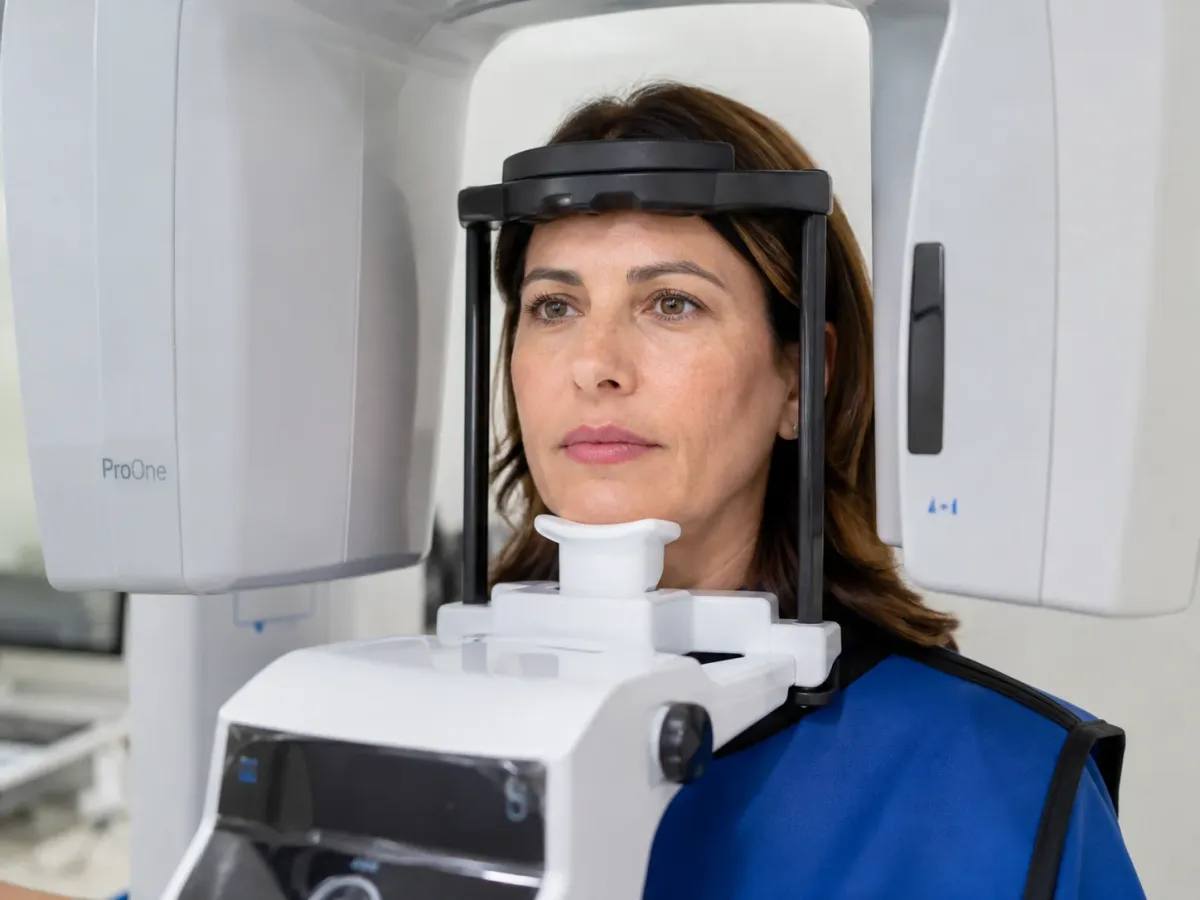
Our digital volume tomography shows the jaw, teeth and nerves three-dimensionally – low-radiation, in seconds, right here in the practice. The foundation for safe planning and honest advice.
3D
instead of a flat image
Seconds
scan time
Low-radiation
modern technology
On site
no referral needed
What it is about
3D diagnostics (CBCT) – briefly explained
A classic X-ray is a flat projection. CBCT delivers a spatial image – bone thickness, nerve pathways, the maxillary sinus, hidden inflammation and the exact position of impacted teeth all become visible. This lets us plan implants to the millimetre, find focal disturbances and avoid surprises during the procedure.
We use CBCT specifically where it adds value: implant planning, wisdom teeth, focal infection search (FDOK/NICO), unexplained pain, the jaw joint, orthodontic questions. We discuss the findings with you on screen.
In detail
When we use CBCT
Planning
Measuring available bone, simulating implant position, protecting the nerve and maxillary sinus – safety for you, precision for us.
- Implant planning
- Wisdom teeth
- Bone augmentation
Finding the cause
Detecting silent inflammation, root remnants, cysts or fractures that remain invisible on a 2D image.
- FDOK / NICO
- Unexplained pain
- Jaw joint
Process
How we proceed
Planned transparently, without surprises – you decide at every step.
Indication
Only when there is added value – we explain why.
Scan
Standing, a few seconds, no preparation needed.
Evaluation
We look at it together on screen.
Plan
Treatment based on exact data.

Your practitioner
Dr. med. dent. Jousef Siouri, M.Sc., M.Sc.
Master in implantology and oral surgery as well as in restorative and aesthetic dentistry, doctorate at RWTH Aachen. His principle: no standard solutions – every treatment is tuned functionally, biologically and aesthetically to the person, and you understand the diagnosis and options before a decision is made.
More about Dr. Siouri and the team →Frequently asked questions
What patients ask us
What's the difference between CBCT and a medical CT scan?
Both give 3D images, but CBCT is designed specifically for the jaw and facial area: a significantly lower radiation dose, higher resolution for teeth and bone, and the scan takes seconds right here in the practice – no referral to a radiology centre needed.
What does a CBCT scan show that a normal X-ray doesn't?
Bone thickness and quality, the exact path of nerves, the sinus, hidden inflammation (e.g. FDOK/NICO), cysts, root remnants and the precise position of impacted wisdom teeth – all in three dimensions instead of a flat projection.
How does the scan work and how long does it take?
You stand comfortably in the device, the scan takes just a few seconds, and no preparation is needed. We go through the results together on screen right afterwards.
I'm a patient at another practice – can I come to you just for a CBCT scan?
Yes – we also carry out CBCT scans on referral and make the data available to your treating dentist.
Is it true that a CBCT scan involves less radiation than a flight?
Yes. A CBCT scan with a small field of view is around 10–50 microsieverts – a flight from Zurich to New York exposes you to more, at 50–100 microsieverts. For comparison: a medical CT scan in hospital delivers 20 to 50 times the dose of a CBCT scan.
Appointment in Freienstein
Let us look together at what fits you.
In the consultation we analyse your situation and give you an honest assessment – without pressure.
Related treatments
You might also be interested in
3D diagnostics (CBCT) – seeing what 2D hides at Zahnarztpraxis Freienstein: we look after patients from Bülach, Embrach, Rorbas, Kloten, Winterthur and the entire Zurich Unterland – biological, metal-free, with time for every person. Parking directly at the practice, appointments bookable online.